Estate Aircraft Appraisal Services in Southern California
The settlement of an estate containing an aviation asset introduces a significant layer of financial complexity and regulatory scrutiny. For executors and legal counsel, securing a defensible estate aircraft appraisal is not merely a procedural step but a critical measure to mitigate liability and satisfy fiduciary duties. The prospect of an IRS audit looms over every valuation, particularly for older turbine aircraft whose extensive maintenance histories require meticulous, expert analysis. Compounding these challenges is the logistical imperative to coordinate physical inspections at high-traffic Southern California airports such as Van Nuys (VNY) and John Wayne (SNA) with minimal disruption to active hangar operations.
This professional guide is structured to provide a clear, methodical framework for navigating this demanding process. We will delineate the critical distinctions between Fair Market Value and Liquidation Value, outline the essential components of a USPAP-compliant report, and detail the methodologies required to produce an accurate, unbiased valuation that withstands rigorous examination. The objective is to equip fiduciaries with the technical knowledge necessary to secure an appraisal report that is both credible in court and defensible before the Internal Revenue Service, ensuring the estate is managed with precision and compliance.
Key Takeaways
Learn the specific legal and federal tax requirements that make a professional, USPAP-compliant valuation a non-negotiable step in estate settlement.
Identify the critical limitations of automated valuation models and why they fail to account for regional factors unique to Southern California aviation assets.
Understand the necessary procedures for coordinating a physical inspection, including managing FBO access and preparing essential aircraft documentation for review.
Differentiate the qualifications of a certified professional capable of producing an IRS-defensible estate aircraft appraisal from a non-certified opinion of value.
Table of Contents
The Critical Role of Estate Aircraft Appraisals in California Probate
USPAP Compliance and Federal Tax Standards for Aviation Assets
Why Automated Valuation Models (AVMs) Fail Southern California Estates
Managing the Appraisal Process at Southern California Airports
OakTree Aviation Services: Certified Valuation Expertise for Los Angeles Estates
The Critical Role of Estate Aircraft Appraisals in California Probate
When an aircraft is included in a decedent's estate, its valuation for probate and tax purposes must be conducted with meticulous precision. An estate aircraft appraisal is a formal, unbiased, and legally defensible opinion of value assigned to aviation assets for the purpose of legal transfer and tax reporting. California probate courts, along with the Internal Revenue Service (IRS), mandate certified valuations for high-value personal property to ensure fair distribution and accurate tax liability assessment. This requirement is fundamental to the administration of high-net-worth estates, where the financial stakes are significant.
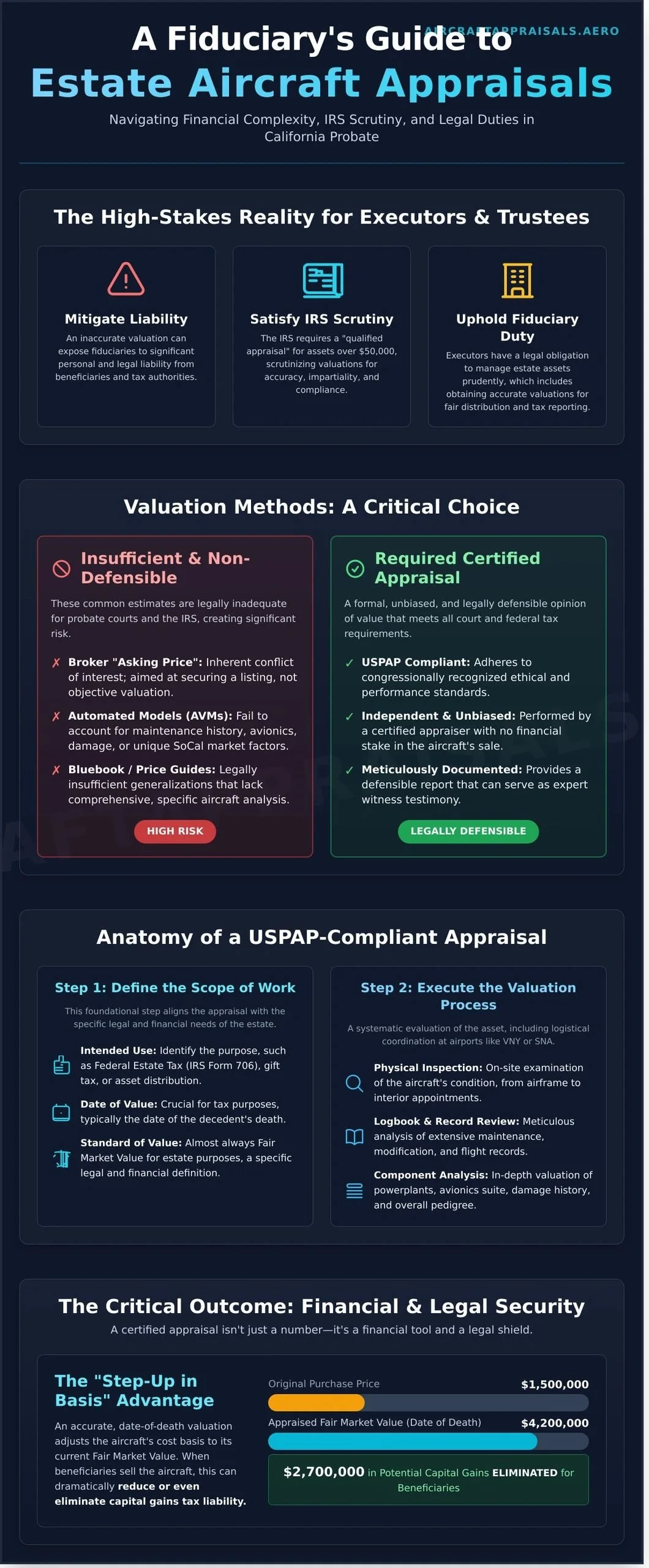
A certified valuation is directly linked to the "step-up in basis" rule under federal tax law. This provision allows the cost basis of an inherited asset to be adjusted to its Fair Market Value on the date of the owner's death. An accurate date-of-death valuation establishes this new basis, which can substantially reduce beneficiaries' capital gains tax liability upon the future sale of the aircraft. Conversely, an inaccurate or unsubstantiated valuation can lead to severe consequences, including significant IRS penalties for underreporting asset values and contentious disputes among beneficiaries, which may culminate in protracted and costly litigation.
Legal Necessity vs. Market Estimates
An executor or trustee cannot rely on informal market estimates, such as a broker's "asking price" or values derived from generalized publications like the Aircraft Bluebook. These figures are legally insufficient as they lack the comprehensive analysis and impartiality required by probate courts and tax authorities. A broker's primary objective is to secure a listing, creating an inherent conflict of interest. In contrast, a certified appraiser acts as an independent, third-party expert whose findings are objective and defensible. The resulting appraisal report serves as expert witness testimony, providing the court with a credible basis for asset distribution and satisfying California's specific tax requirements for aviation assets.
Determining the Scope of Work
The foundation of any defensible estate aircraft appraisal is a clearly defined Scope of Work, established in compliance with the Uniform Standards of Professional Appraisal Practice (USPAP). This critical initial step ensures the valuation methodology aligns with the specific legal and financial requirements of the estate. Key parameters that must be unequivocally identified include:
The Intended Use: The valuation may be required for federal estate tax filings (IRS Form 706), gift tax considerations, or internal family settlement and asset distribution.
The Date of Value: This is typically the date of the decedent's death, though an alternate valuation date may sometimes be elected under specific IRS regulations.
The Standard of Value: For estate purposes, the required standard is almost always Fair Market Value, a specific legal and financial definition distinct from other standards like Fair Value.
USPAP Compliance and Federal Tax Standards for Aviation Assets
The Uniform Standards of Professional Appraisal Practice (USPAP) represent the congressionally recognized ethical and performance standards for the appraisal profession in the United States. In the context of aviation, adherence to these standards is not merely a best practice; it is a foundational requirement for producing a credible and defensible valuation. The Internal Revenue Service specifically requires a "qualified appraisal" for assets exceeding $50,000, and a USPAP-compliant report is structured to meet these stringent federal criteria. As detailed in the IRS Technical Guidelines for Estate and Gift Tax, the valuation methodology must be thoroughly documented and executed by a qualified, objective professional.
The clinical methodology of a certified estate aircraft appraisal involves a systematic evaluation of every major component, from the airframe and powerplants to the avionics suite and interior appointments. A critical component of this process is the appraiser’s strict independence from any transaction related to the aircraft. Our certified reports are prepared by professionals who derive no financial benefit or commission from the future sale of the asset, ensuring the final valuation is an unbiased, defensible figure suitable for probate court, estate tax filings, and equitable distribution among beneficiaries.
The Anatomy of a USPAP-Compliant Report
A valuation report intended for federal tax purposes must contain specific, verifiable elements to withstand scrutiny. Key components include:
Required Certifications: The report must feature the appraiser’s signed statement of neutrality, certifying their disinterested position, adherence to USPAP standards, and a full disclosure of the valuation methodology employed.
Detailed Aircraft Description: This section provides an exhaustive account of the aircraft’s physical condition, including total airframe time, engine specifications, avionics inventory, and the status of the paint, interior, and modifications.
Market Data Analysis: A credible valuation is supported by an analysis of truly comparable sales. Our methodology involves identifying recent transactions in the current 2026 market, adjusting for differences in equipment, maintenance status, and overall condition to arrive at a precise value conclusion.
Maintenance Logbook Audits: The Hidden Value
The completeness and continuity of an aircraft's maintenance records are arguably the single most significant factors influencing the valuation of turbine-class aircraft. A thorough logbook audit is an essential step in any professional estate aircraft appraisal. This forensic review involves analyzing critical data points, such as Time Before Overhaul (TBO) for engines and the status of life-limited components, to provide a clear financial forecast for the estate. A material deficiency in these records, such as missing logbooks, can devalue an airframe by up to 50%.
A Fiducitary’s Guide to Estate Aircraft Appraisal
Why Automated Valuation Models (AVMs) Fail Southern California Estates
For executors and trustees managing aviation assets in probate, the temptation to use automated valuation models (AVMs)-often referred to as "Bluebook" values-is understandable due to their speed and low cost. However, reliance on these subscription-based software tools for a formal estate aircraft appraisal is a significant fiduciary risk. These platforms generate values based on national sales averages and standardized depreciation curves, fundamentally failing to account for the specific physical, environmental, and market conditions unique to Southern California.
An AVM cannot physically inspect an airframe for the subtle but costly effects of corrosion accelerated by the coastal marine layer, nor can it identify undocumented damage history that is only discoverable through a meticulous on-site examination and logbook audit. These factors can create a substantial variance between a software-generated number and the aircraft's true Fair Market Value, a discrepancy that can lead to significant tax liabilities or legal challenges.
Bluebook vs. Certified Appraisal
A certified appraisal provides a tail-number specific valuation based on a comprehensive physical and documentary audit, whereas AVMs rely on aggregated, non-specific data. Software is incapable of judging the actual condition of a bespoke interior, the operational status of a complex avionics suite, or the quality of maintenance compliance. Consequently, valuation reports generated by AVMs are frequently challenged and rejected by IRS auditors in high-value estate cases, which demand a defensible, USPAP-compliant methodology.
The Local Market Factor: Southern California Values
The definition of "Fair Market Value" is heavily influenced by local market dynamics. The high concentration of business jets at airports such as Van Nuys (VNY) creates a distinct micro-market with its own supply and demand characteristics. Furthermore, California's stringent environmental and operational regulations can impact an aircraft's desirability and value. Understanding these state-level financial nuances, which are part of a complex ownership picture detailed in resources like AOPA's Pilot's Guide to Taxes, is critical for an accurate valuation that differs from national averages.
Case Study: A recent desktop appraisal of a Gulfstream jet based at a Los Angeles airport yielded a value determined by its make, model, and year. However, a subsequent on-site inspection conducted for the estate settlement discovered significant deferred maintenance items and early-stage corrosion not apparent in digital records. These findings, invisible to any AVM, resulted in a downward value adjustment of over $200,000, demonstrating the critical necessity of a physical assessment for an accurate and defensible estate aircraft appraisal.
Managing the Appraisal Process at Southern California Airports
Executing a certified aircraft valuation for estate or probate purposes involves a methodical, multi-step process. Success requires careful coordination with airport authorities, Fixed Base Operators (FBOs), and maintenance facilities. A professional appraiser manages these complexities to ensure the on-site inspection is conducted efficiently and that all necessary data is collected for an accurate and defensible report. The process moves sequentially from logistical planning to the final delivery of a USPAP-compliant valuation.
Logistics at Major SoCal Hubs
Navigating high-security environments at airports such as Van Nuys (VNY) or John Wayne (SNA) requires proactive coordination. The appraiser will arrange access with the relevant FBO, provide the necessary insurance certificates, and adhere to all security protocols. For aircraft at facilities such as Hollywood Burbank (BUR), we work directly with maintenance shops to schedule logbook reviews. Executors should anticipate a timeline of approximately five to seven business days from engagement to the delivery of the final report, contingent on aircraft and record accessibility.
Preparing the Aircraft for Inspection
The accuracy of an estate aircraft appraisal depends directly on the quality and completeness of the documentation provided and on the physical accessibility of the asset. The executor or representative must ensure the appraiser has access to all pertinent records. "Clean," well-organized logbooks are as critical as the aircraft's physical condition, as they provide verifiable proof of maintenance history, component times, and compliance with airworthiness directives.
Required Documentation: A complete set of maintenance logbooks (airframe, engine, propeller), the current Airworthiness Certificate, Certificate of Registration, and a detailed equipment list.
Physical Access: The aircraft should be moved from its hangar, if necessary, to allow unobstructed exterior photography and a thorough inspection of the airframe, engines, and control surfaces.
Systems Check: While not a pre-buy inspection, a powered-up cockpit allows the appraiser to verify the functionality and inventory of the installed avionics suite.
Following the physical inspection and logbook audit, the appraiser conducts comprehensive market research, cross-referencing data from multiple sources to determine the aircraft's fair market value. This diligent, off-site analysis culminates in the issuance of a certified, USPAP-compliant valuation report suitable for submission to the IRS, legal counsel, and probate court. To initiate a compliant estate aircraft appraisal, contact our team at aircraftappraisals. aero.
OakTree Aviation Services: Certified Valuation Expertise for Los Angeles Estates
For legal professionals and fiduciaries managing complex estates, a certified estate aircraft appraisal is a non-negotiable requirement for IRS compliance and equitable asset distribution. Led by Senior Certified Aircraft Appraiser Jeremy Cox, the OakTree Aviation Services team brings over 25 years of direct, clinical aviation experience to every valuation engagement. Our firm is founded on the principle of providing strictly unbiased, fee-based valuation services, a structure that guarantees our findings are free from the conflicts of interest inherent in broker-appraiser models.
Our specialization focuses on high-value, technically complex aviation assets commonly found in Southern California estates. This includes a comprehensive understanding of the valuation methodologies for:
Business and Corporate Jets
Single and Multi-Engine Turboprops
High-Performance Piston Aircraft
This focused expertise ensures that every component, from airframe and engine times to avionics suites and logbook provenance, is meticulously analyzed to produce a defensible and accurate fair market value.
Professional Credentials and Reliability
OakTree Aviation Services operates in strict compliance with the Uniform Standards of Professional Appraisal Practice (USPAP), with all reports certified to the most current 2026 standards. Our appraisers hold Senior Certified status, the highest designation available. This commitment to rigorous standards has established our reputation for precision among leading Southern California law firms and financial institutions. Furthermore, our team possesses extensive experience providing expert witness testimony, with valuation reports that have been successfully defended in California Superior Court proceedings.
Next Steps for Executors and Attorneys
Engaging our firm for an estate aircraft appraisal is a structured and transparent process designed for legal and financial professionals. The initial steps are straightforward:
Request a Fixed-Fee Quote: We provide a comprehensive, all-inclusive quote for an on-site certified appraisal, ensuring no billing surprises.
Schedule an Initial Consultation: A no-obligation discussion to define the specific scope of work, establish the effective date of valuation, and outline the timeline required for your legal or probate matter.
Contact Our Office: For immediate assistance or to initiate the appraisal process, please contact our Los Angeles office directly.
To learn more about our qualifications or to begin a consultation, please visit aircraftappraisals.aero.
Ensuring Fiduciary Compliance with Certified Aviation Valuations
The administration of an estate involving aviation assets in Southern California requires a meticulous, legally sound approach to valuation. As this guide has detailed, adherence to USPAP and federal tax standards is mandatory for legal and IRS defensibility, and reliance on automated valuation models presents an unacceptable risk. The successful execution of a professional estate aircraft appraisal, therefore, depends on engaging a certified expert who can conduct a thorough physical inspection and a comprehensive logbook analysis to produce an accurate, unbiased, and irrefutable valuation.
OakTree Aviation Services, led by Jeremy Cox with over 25 years of specialized experience, provides this essential expertise. Our firm delivers USPAP-compliant reports for all turbine, piston, and rotary-wing assets, providing fiduciaries with the definitive documentation required for probate and tax proceedings. For a valuation that meets the highest standards of accuracy and legal defensibility, Request a USPAP-Compliant Estate Appraisal in Southern California. Secure the certainty and compliance your fiduciary duties demand.
Frequently Asked Questions About Estate Aircraft Appraisals
What is the difference between a desktop appraisal and a certified on-site appraisal for an estate?
A desktop appraisal is a valuation based on owner-supplied data, specifications, and digital records without a physical inspection. While less costly, it cannot independently verify the aircraft's condition. A certified on-site appraisal involves a thorough physical examination of the airframe and the original logbooks by a qualified appraiser. This method provides the highest level of accuracy and legal defensibility, which is essential for IRS and probate court proceedings where unbiased verification of value is paramount.
Does the IRS require a USPAP-compliant appraisal for an aircraft in a California estate?
The IRS requires a "qualified appraisal" from a "qualified appraiser" for high-value assets. While USPAP (Uniform Standards of Professional Appraisal Practice) is not explicitly mandated by name, a USPAP-compliant report is the industry standard that meets and exceeds all IRS requirements for a defensible valuation. Adhering to USPAP provides a structured, impartial, and well-supported opinion of value that is designed to withstand the scrutiny of federal tax authorities, making it the most prudent course of action.
How long does the on-site inspection of a business jet typically take in Southern California?
The duration of an on-site physical inspection is contingent on the aircraft's size, complexity, and the organization of its maintenance records. For a mid-size business jet, such as a Citation XLS or Learjet 60, a comprehensive inspection and initial logbook review typically requires four to six hours. Larger, more complex aircraft, or those with disorganized documentation, may require additional time to ensure a thorough and accurate assessment is completed in accordance with professional appraisal standards.
Can an aircraft appraisal be backdated to the date of death for probate purposes?
Yes, this is referred to as a retrospective appraisal. A certified appraiser can determine the Fair Market Value of an aircraft effective on a specific historical date, such as the date of death. This valuation is not based on current market conditions but rather on market data, comparable sales, and aircraft-specific factors relevant at that time. This process is a standard and necessary requirement for accurately establishing asset value for estate tax and distribution purposes.
What happens if the maintenance logs for the estate aircraft are missing or incomplete?
Missing or incomplete maintenance logbooks will have a significant and adverse impact on the aircraft's valuation. An appraiser must document this deficiency and quantify the resulting diminution in value, which can be substantial. The absence of a complete history creates uncertainty regarding component times, damage history, and compliance with Airworthiness Directives. This uncertainty poses a major liability, severely limiting the aircraft's marketability and reducing its Fair Market Value relative to an aircraft with complete records.
How much does a certified aircraft appraisal cost for a Southern California estate?
The cost for a certified estate aircraft appraisal is determined by the aircraft type, its location, and the required scope of work. For a standard single-engine piston aircraft located in Southern California, a certified on-site appraisal typically starts at approximately $1,500. Valuations for more complex assets, such as multi-engine turbine or jet aircraft, are quoted on an individual basis due to the increased time required for logbook research, systems analysis, and market data compilation.
Is a "market analysis" from a broker the same as a certified appraisal?
No, they are fundamentally different. A market analysis or Broker Opinion of Value (BOV) is a marketing tool created to list the aircraft for sale and inherently creates a conflict of interest. A certified appraisal, conversely, is an independent and unbiased valuation performed by a disinterested third-party appraiser in compliance with USPAP standards. For legal and tax purposes, such as probate and estate filings, only a certified appraisal is considered a defensible and credible valuation.
Can OakTree Aviation Services provide expert witness testimony if the estate valuation is contested?
Yes, OakTree Aviation Services' senior appraisers are qualified to provide expert witness testimony in legal proceedings. Our certified reports are prepared from the outset to be legally defensible and withstand the scrutiny of litigation. Should an estate aircraft appraisal be contested in court, our experts can effectively articulate and defend the valuation methodology and conclusions during depositions or trial, providing essential litigation support for executors, beneficiaries, and their legal counsel in California and other jurisdictions.